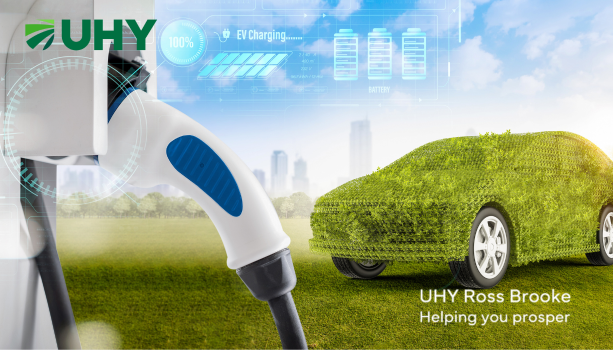
 For years I have been promoting the tax benefit of EVs to my OMB clients. Full tax relief on the purchase in year one, a benefit in kind charge in single figures, and no fuel bills at the pump. It was hard to argue with.
By Chris Davies – Partner
However, that case is now being chipped away from several directions at once. The Autumn Budget and the Finance Bill that followed did not announce one dramatic change. Instead, a series of smaller measures, some new and some already in the pipeline, add up to a much less generous picture from April 2027 onwards.
The 100% first year allowance ends in April 2027
The biggest change for owner-managed companies is the loss of the 100% first year allowance (FYA) on new electric cars. It currently lets a company deduct the full cost of a new, unused zero-emission car from its profits in the year of purchase.
From April 2027, an electric car bought by a company will instead go into the main capital allowances pool. It is also specifically excluded from the new 50% first year allowance that the Government is introducing for other plant and machinery.
Slower relief in a smaller pool
The main pool is itself becoming less generous. The main rate writing down allowance fell from 18% to 14% in April 2026, and the Finance Bill 2026-27 cuts it again to 12% from 1 April 2027 for companies (6 April for unincorporated businesses).
Take a company paying corporation tax at 25% and buying a £50,000 electric car:
Bought by 31 March 2027 | Bought from 1 April 2027 | |
Allowance in year one | £50,000 (100% FYA) | £6,000 (12% WDA) |
Tax saved in year one | £12,500 | £1,500 |
The total relief is not lost, but it now trickles in over many years rather than arriving up front. For a small company, that cash flow difference is real.
Benefit in kind keeps climbing
The benefit in kind rate on a fully electric company car was 2% as recently as 2024/25. It is 4% this year and is already legislated to rise to 5% in 2027/28, 7% in 2028/29 and 9% in 2029/30. The Budget has now added 10% for 2030/31, with the top rate for petrol and diesel cars rising to 40%.
On a £50,000 electric car, a higher rate taxpayer pays £800 a year in tax on the benefit today. By 2030/31 that becomes £2,000, and the company’s Class 1A National Insurance on the same car rises from £300 to £750.
On top of the company tax changes, all electric car drivers face a new running cost. Announced in the 2025 Budget, Electric Vehicle Excise Duty (eVED) starts on 1 April 2028 at 3p per mile for battery electric cars and 1.5p per mile for plug-in hybrids, rising with inflation in later years. It will be collected alongside normal Vehicle Excise Duty, which electric cars have paid since April 2025.
For a car covering 10,000 miles a year, that is around £300 for an EV and £150 for a plug-in hybrid. The Government points out that 3p is roughly half the fuel duty paid by the average petrol or diesel driver. Even so, it removes one of the last running cost advantages that EVs had all to themselves, and it lands on high-mileage business users hardest.
Mixed messages from the Government
All of this sits awkwardly beside the Government’s public support for electric vehicles.
There is some logic to the Government’s position. Fuel duty raises billions each year, and that income shrinks with every driver who switches. Tax breaks designed to kick-start a new market were never meant to last forever, and EVs now make up a large share of new company car orders. Seen that way, the Treasury is simply bringing EVs into the tax system as they become mainstream.
The risk is in the timing and the signal. The Office for Budget Responsibility estimated that pay-per-mile charging alone could mean around 440,000 fewer electric cars on the road. Businesses plan fleet decisions years ahead, and a steady drip of less favourable measures makes that harder. Encouraging take-up with grants for private buyers while reducing incentives for company fleets, which drive a large share of new car sales, is a difficult balance to defend.
What this means for directors
An electric company car is still likely to be more tax efficient than a petrol or diesel one for most directors. What has changed is that it is no longer the easy decision it once was, and the numbers now need running properly.
If you are already thinking about a new EV through your company, the timing matters. Buying before 1 April 2027 could secure the full 100% first year allowance. The car must be new and unused, and the date the expenditure counts as incurred depends on how it is financed, so check this before you sign.
It is also worth comparing company ownership with alternatives such as leasing, salary sacrifice for employees, or owning the car personally and claiming mileage.
At UHY Ross Brooke, we help owner-managed businesses work through these choices. If you are planning a vehicle purchase in the next year, get in touch with your usual UHY Ross Brooke contact and we will help you find the most tax-efficient route.