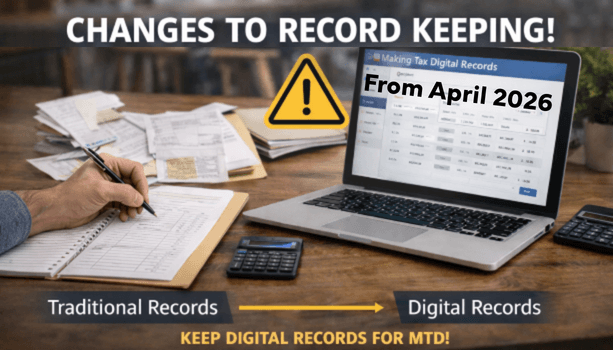
 Making Tax Digital (MTD) for Income Tax has now been live for seven months, and the second quarterly deadline passed on 7 November. For the first group of sole traders and landlords, those with qualifying income over £50,000, the early results are mixed.
By Chris Davies – Partner
Of the 864,000 people expected to follow the new rules, 436,000 sent their first quarterly update by the August deadline. That is roughly half. So far the cost of falling behind has been low, because HMRC is not issuing penalty points for late quarterly updates in this first year. That changes from April 2027.
April 2027 is also when the next, larger group joins: sole traders and landlords with qualifying income over £30,000.
Six common mistakes from the first quarters
- Treating a quarterly update like a tax return. An update is a short summary of your business or property income and expenses. No tax is calculated and nothing is paid when you send it. Your tax bill is only worked out when you file your final return for the year.
- Not signing up at all. Before the first deadline, only about 570,000 people had registered, well short of the number expected. HMRC began signing up eligible taxpayers automatically from September 2026. A letter from HMRC does not mean you are ready, though. You still need the right software and digital records.
- Sending a “nil” update to buy time. It is tempting to file a blank placeholder just to meet the deadline. This creates a messy correction later. Send real figures, even if they are late.
- Resending an update to fix an error. You do not need to. Correct the record in your software as soon as you spot the mistake, and the change will flow into your next quarterly update.
- Getting confused about calendar quarters. You can choose quarters that end on the last day of a month (for example 1 April to 30 June) instead of the standard tax-year quarters. During HMRC’s testing, confusion over this choice was the most common reason submissions failed. Pick one approach and make sure your software matches it.
- Leaving the bookkeeping until the deadline. Owners who coped best built a routine, such as logging receipts weekly and linking their business bank account to their software. Those who left it to the last week found each quarter felt like a mini tax return.
How the penalties work
MTD comes with two separate penalty systems: one for filing late and one for paying late.
Late filing: a points system
- You get one penalty point for each missed deadline. That covers each quarterly update and the final tax return.
- Once you reach four points, HMRC charges a £200 penalty.
- Every late submission after that costs another £200. No more points are added, but the fines keep coming.
- Below the threshold, each point expires after 24 months. Once you hit the threshold, you clear your points by filing on time for 12 months and sending any outstanding updates.
- If you have more than one business, such as a sole trade and a rental property, missing the same deadline for both counts as one point, not two.
- Income Tax points are counted separately from any VAT penalty points.
A mistake in a quarterly update does not earn a point. Simply correct it in your records.
Late payment: a percentage of what you owe
Quarterly updates do not create a tax bill, so late payment penalties apply to your normal Self Assessment payments. Pay within 15 days of the due date and there is no penalty. After that, HMRC charges a percentage of the unpaid tax that rises the longer it stays unpaid, plus interest.
The first-year grace period is ending
If you joined in April 2026, you will not receive penalty points for late quarterly updates during 2026/27. This relief does not cover late payment, or a late final return for the year. Points for late quarterly updates apply to everyone from 6 April 2027. If you join MTD in April 2027, you will not get a grace year. Points apply from your very first update.
What to do now
If you are already using MTD
- Catch up on any missed updates. They must all be sent before you can file your final return for the year, so do not let them pile up.
- Diary the next two deadlines. The third update (6 October to 5 January) is due by 7 February 2027, and the fourth by 7 May 2027.
- Keep your 31 January 2027 deadline in view. Your 2025/26 Self Assessment return and any tax due are still handled under the old system.
- Fix the habits that caused stress. If the first two quarters were a scramble, set a weekly or monthly bookkeeping routine before points start to count in April.
If you join in April 2027
- Check whether you are in scope. Add up your gross income from self-employment and property, before expenses, as shown on your 2025/26 return. Above £30,000 means you must join.
- Sign up. Register through GOV.UK rather than waiting for HMRC to contact you.
- Choose your software. Options range from free apps to full accounting packages. If you prefer spreadsheets, you can keep them and connect them to HMRC using bridging software.
- Practise before it counts. Run your records through the software for a quarter or two before April, so the first real update is routine.
- Check for an exemption if you need one. People who genuinely cannot use digital tools can apply to be exempt.
Talk to us before April
Year one has shown that MTD is manageable for those who prepare, and stressful for those who don’t. With penalty points starting in April 2027 and a new group joining at the same time, the next few months are the best time to get your systems in order.
At UHY Ross Brooke, we help sole traders and landlords choose the right software, set up digital records and handle their quarterly updates. Book a free initial call to make sure you are ready.